
Exhuma Webtoon and Colony Game Show a New Expansion Playbook for Korean Film IP
Exhuma and Colony point to how Korean hit films are extending value beyond theaters through webtoons, graphic novels and games.
The film Exhuma and Colony are pointing in the same direction: a successful Korean film no longer has to end its commercial life at the theater. Its story, characters and genre appeal can move into webtoons, graphic novels and games, creating new revenue paths and new points of contact with fans. Through the expansion strategies around these two titles, the Korean film industry is testing how intellectual property can be redesigned after box-office success rather than simply preserved as a completed theatrical product.

The broad theme may be “world-building,” but the more precise issue is how each project chooses to extend itself. Exhuma is taking already proven characters and moving their past into the storytelling grammar of a webtoon. Colony, meanwhile, is using an ongoing box-office run as the launch point for a follow-up medium. The contrast suggests that Korean cinema is moving beyond the stage in which IP management meant waiting for a sequel alone.
The calculation behind Exhuma’s move into webtoons
The Exhuma spin-off webtoon Maengjong began serialization on Naver Webtoon at 10 p.m. on May 30. According to the official materials cited in the source, the central point of the series is not to retell the events of the film. Instead, it goes back to the high school years of Hwa-rim and Bong-gil and follows how the two first become connected. The title Maengjong, presented with the meaning of unconditional following or obedience, brings the film’s shamanic and occult atmosphere into the longer rhythm of serialized webtoon storytelling.
That choice matters because the characters function differently across the two media. In the film, Hwa-rim and Bong-gil left a strong impression, but the running time could not linger over the beginning of their relationship. A webtoon is well suited to filling that blank space. It can begin from faces and names the audience already recognizes, while allowing readers to return each week to consume the world again through new incidents and emotional beats.
The key, however, is that this is not merely an add-on product attached to a hit film. Naver Webtoon’s global reader network is broader than a theatrical audience, and vertical-scroll horror works differently from a jump scare in a cinema. It can use mood, panel spacing and pauses between cuts as tools of suspense. The tense character-relationship style of writer Haemuri, together with early planning review by director Jang Jae Hyun, can be read as a device for translating the film’s emotional and genre texture into the rules of another medium, rather than simply borrowing popular characters from the original work for a side story.
Colony chooses a game instead of a sequel-first route
The expansion of Colony starts from a different point. After opening on May 21, the film had reached the 4.12 million cumulative-admissions range as of related box-office reports on the morning of June 5, and it had held the No. 1 position at the box office for 15 consecutive days. If Exhuma brought out character backstory after passing the 10 million-viewer mark, Colony is a case in which the next medium for the world is being presented while the film’s theatrical success is still underway.
The comparison of box-office scale at the starting point of each film IP expansion is therefore significant. Exhuma is being treated as a title that surpassed 10 million admissions, while Colony is being compared as a title in the 4.12 million cumulative-admissions range based on reports from the morning of June 5, 2026. The unit used in the comparison is ten thousand admissions, placing Exhuma at 10 million-plus and Colony in the 4.12 million range.
The direction described by director Yeon Sang Ho is even clearer. Rather than moving first to a film sequel, the plan is to build the foundation of the world through a graphic novel and then develop an animation-style game based on it. This is different from a strategy that simply asks viewers to wait for the next movie. It seeks to turn viewers into players and to convert the setting of a closed building and a collective infected body into rules that can be directly manipulated.
What the two cases reveal about OSMU
Placed side by side, the two examples show that the use of OSMU, or one-source multi-use, is changing. Earlier OSMU strategies often resembled the practice of placing the name value of a hit work onto other products. The current mode of expansion is closer to rearranging the unanswered questions that each medium leaves behind. Exhuma draws out the characters’ past and their relationship. Colony draws out the rules of infection and the possibilities of survival-game play.
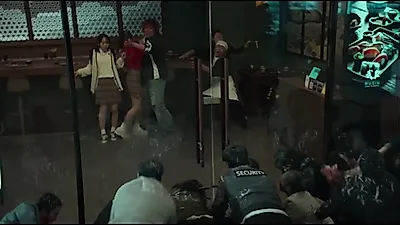
Colony is especially meaningful within Yeon Sang Ho’s zombie filmography. If Train to Busan and Peninsula expanded the zombie genre through moving spaces and a collapsed world, Colony foregrounds the premise that the infected share a single consciousness and evolve. In the official trailer imagery, several figures are compressed into one space, and the title itself points not to an individual monster but to a collectivized being. That is also where its suitability for adaptation into a game begins.
By contrast, Maengjong expands the emotional line and origin story of the film rather than translating its horror into action rules. Webtoon readers can spend longer following why the characters became who they are, rather than focusing only on how a case ends. Even within the same category of film IP expansion, Colony is widening rules, while Maengjong is digging deeper into relationships.
The next checkpoint is the quality of the media transition
For this trend to succeed, box-office numbers alone will not be enough. Maengjong must turn the appeal that film fans already recognize in Hwa-rim and Bong-gil into weekly immersion for webtoon readers. The planned Colony game must persuade audiences that the film’s setting has become genuine play rules, not a simple promotional mini-game. World expansion is not completed merely because different works share the same name.
The next checkpoints are therefore clear. For Maengjong, the question is how convincingly the early chapters establish Hwa-rim and Bong-gil’s first connection as an independent story. For Colony, the question is how the graphic novel and game announcement stages turn the infected body’s collective intelligence into an experience players can control. The success or failure of these two projects will become a test of whether Korean film IP can remain a real asset outside the theater.
Related articles